By Akin Akinyemi
Transportation is one of the fundamentals of development, and access to same, remains pivotal to the growing of the economic and social derivatives of any strategic effort at bringing about the kind of expansion and progress that the present administration under the leadership of Prince Dapo Abiodun, is working assidulously to entrench in Ogun State. From time immemorial, parameters that guarantee effective transportation in all evolving societies have defined the extent to which such societies advance in all developmental spheres; whether it be with respect to diplomacy, trade and commerce, investment opportunities and its attraction of would-be investors among others.
First up, the State Government, recognizing the importance of good road network as a veritable imperative of durable transportation, embarked on the construction and rehabilitation of roads throughout the State. This has led to the construction and rehabilitation of more than 600 kilometers of roads throughout its nooks and crannies. And with a vibrant collaboration with the Federal and Local tiers of Government, rural roads are being opened up, particularly with the support of the Rural Agricultural Access Mobility Programme, (RAAMP). This is with a view to ensuring easier movement of produce from the farm to markets.
Furthermore, the creation of a full-fledged Ministry of Transportation, from the now defunct Bureau of Transportation, represented another, in a series of structural realignments embarked upon by the State Governor, geared towards the commencement of initiatives that would help engender a systematic transport mechanism in our State.
Then, the government embarked on the very bold initiative of constructing the Agro-cargo airport in Iperu, a feat which was achieved in record time, with regular commercial flights billed to commence anytime soon. As all necessary preparations continue to take shape, for the commencement of commercial flights, allied structures such as an agro-processing zone, a housing estate, offices of line agencies such as the Immigrations and Customs, along with the National Drug Law Enforcement Agency are being constructed, leading to the establishment of an aerotropolis in our state.
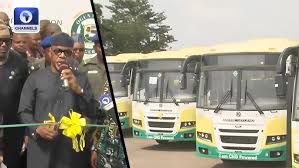
The State Government, responding to the effects of the removal of fuel subsidy by the Federal Government, as part of the economic reforms put in place by President Bola Tinubu, contracted foreign technocrats to convert some of the Government-owned automobiles from fuel combusted engines to natural gas. By this, Ogun State became the first to introduce CNG-enabled vehicular machines into its fleet. Since then, the workers’ bus, and a host of vehicles plying the intra-state corridors are being run on Compressed Natural Gas.
And when the Ogun State Governor Prince Dapo Abiodun, was commissioning the CNG-vehicles, he pledged the introduction of electrically powered automobiles into the State transport architecture. Tagging this ‘’The State E Mobility Programme’’, it was billed as a means of lessening the burden of cost to the commuter, owing to the high cost of fuel. Much more however, it has become extremely desirable, as a result of its environmentally friendly potential, thereby mitigating the negative effects of fossil fuels on the state eco-system, Thus, reducing its effect on climate change.
On Wednesday, the 31st of July, Prince Abiodun, actually launched e-bikes and tricycles, under the Ogun State E-Mobility Programme. This launch at the Governor’s Office Arcade Ground, Oke-Mosan in Abeokuta, represented the introduction of the first phase of 2,000 electric motorcycles by the State Government, in its resolve to make lives more bearable for citizens of the State, thus mitigating the impact of the removal of subsidy on petrol.
Apart from the foregoing, it is hoped that the programme would reduce the cost of transportation, bringing about cleaner environment by reducing carbon emissions.
Launching the Programme, Prince Abiodun affirmed that E-Mobility heralded another milestone in his avowed commitment towards ensuring sustainability of the State’s socio-economic development. He stated that the investment would be in three phases: “beginning with phase one, with a focus on our e-Okada bike assembly, phase two with the tricycles and phase three with our e-vehicles, providing 10,000 direct jobs and 50,000 indirect jobs with assembly line operators”.
Reaffirming his administration’s commitment to mitigating the impact of the subsidy removal, which has understandably led to the high cost of diesel fuel also, by doing all he can to ensure the reduction of transportation cost on citizens; the Governor opined that he had led the country in the energy transition agenda; being the first state to launch and deploy Compressed Natural Gas (CNG) Buses in the Mass Transit Buses routes.
Reiterating the successful conversion of buses from the usage of fuel to Compressed Natural Gas by his administration, the Governor announced the obvious; that the buses were currently deployed on the Ita-Oshin-Adatan route in Abeokuta, Mowe-Ibafo to Lagos and other routes, serving residents in these corridors and reducing transportation fares drastically.
“We will be launching about 2,000 e-bikes for the first phase. These commercial motorbikes can ride up to 75-80 kilometres on full charge and the vehicles up to 200 kilometres, thus reducing transportation cost by 40 percent.
“We aimed to reduce our carbon footprint and bring about a significant change in how we think about transportation of our daily lives. This aligns with our energy transformation programme for a cleaner and healthier environment for future generations.”
“Through this launching of electric bikes, tricycles, vehicles, motorcycles and the battery swap stations at specific points, we are not just introducing a new mode of transportation, we are pioneering a movement towards a cleaner, more efficient and technologically advanced way of life.”
In the meantime, it can be worrying to observe that one of the greatest potential challenges posed by the introduction of new policies or programmes into the Nigerian socio-polity, is that of sustainability. An astute businessman such as Prince Abiodun, has never been lost on this, as an important component of success in his programme agenda for the State’s development. You recall that such acumen has already found expression in the idea of an aerotropolis in Iperu, implying the development of a city, with the airport being its center-piece.
In the same vein, the Governor, in launching the e-bikes and electric tricycles, announced the ground breaking of a new facility, named Giga Facility, at the Special Agro Processing Zone located at Iperu-Remo. In making this announcement, the Governor stated that the facility with a total investment sum of 40 million Dollars, would be an assembly plant for the electric bikes, two wheelers, tricycles, commercial buses, electric cars and swap stations also.
Happily, the launch was witnessed by the Minister of Transportation, Senator Seidu Alkali, an indication of the significance of the event as an epoch-making one. Understandably, the Minister lauded Ogun, for being the first State to launch such a programme, adding that it had joined other African countries currently making use of more than 15,000 e-bikes as part of their transport architecture. Asserting that apart from the fact that the programme would revolutionize the transportation sector in the state in particular and the country at large, it would also provide alternative means to fuel and reduce cost. Senator Alkali, therefore urged other state governments to take a cue from Ogun in partnering with the Federal Government in CNG usage. He also called on members of the public to support the programme which is guaranteed to create jobs, while making transportation cheaper, efficient and eco – friendly.
Coming as a follow up to the conversion of mass transit to CNG buses last year, towards addressing increase in transportation fare occasioned by subsidy removal, the Prince Dapo Abiodun led administration in the State, is by the introduction of Electronic bikes and electronic tricycles, in addition to other important strategic policies and programmes, is slowly but surely, demonstrating a firm commitment to a sustainable revolution in the Transportation sector, which will overtime further the entrenchment of its status as the nation’s investment destination of choice for the proletariat, bourgeois and perhaps the elite also.
Akin Akinyemi is a Civil Servant, writing from Abeokuta.
Akinoakins@gmail.com
 Upperhill News
Leave a comment